
Every Ottawa homeowner looks at their backyard in May with the same thought: This is the year I'm building that deck. By July, half of them are still looking at the same patch of grass, waiting for a contractor callback. The other half started in February.
That's not a guess. It's how deck season works in this city. Ottawa gives you exactly five months of deck weather. If you count the blackfly weeks in June and the mosquito siege in August, it's really more like three and a half. The contractors who build decks know this, which means their schedules fill months before the first frost-free morning.
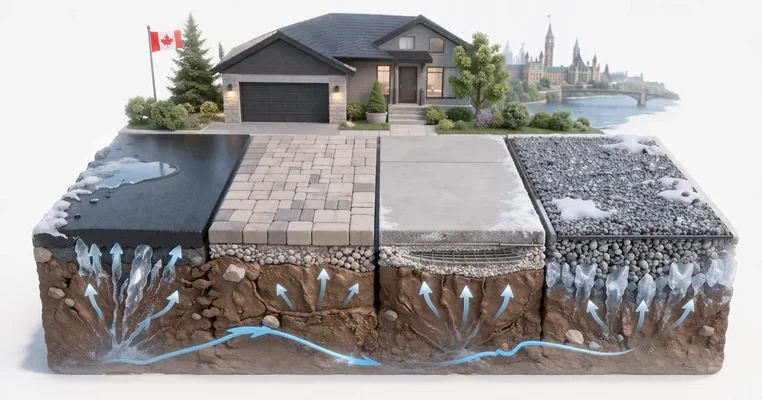
But timing is only the first challenge. The bigger one is under your feet. Ottawa sits on Leda clay, a post-glacial marine sediment that expands when wet, shrinks when dry, and heaves when it freezes. Building a deck on this stuff without proper footings is like building a bookshelf on a waterbed. It will move. It will shift. And eventually, it will pull away from your house.
Here's everything you need to know before you start: permits, materials, footings, costs, and the mistakes that turn a $10,000 project into a $15,000 lesson.
Do You Need a Permit? (Probably Yes)
The City of Ottawa requires a building permit for any deck that meets either of these conditions:
- Height: The deck surface is more than 600mm (about 24 inches) above the adjacent ground level
- Attachment: The deck is structurally attached to the building
That covers most decks people actually want to build. The only common exception is a freestanding, ground-level platform deck sitting directly on grade. If you're building something you can step onto from the back door without stairs, and it's not bolted to the house, you might be exempt.
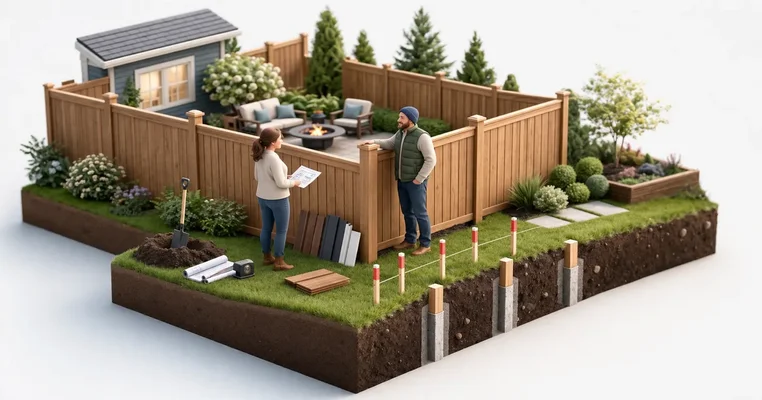
The permit application requires a site plan showing property lines, setbacks, and the deck's position relative to your house. You'll also need construction drawings showing footings, framing, beam sizes, and railing details. For a straightforward residential deck, the permit typically costs between $100 and $300.
Heritage Districts: An Extra Layer
If your home is in a heritage conservation district (parts of the Glebe, Sandy Hill, New Edinburgh, Rockcliffe Park, or Lowertown), you may need heritage approval in addition to the building permit. This can add weeks to your timeline. If the deck is visible from the street, expect scrutiny on materials and design that matches the neighbourhood's character.
Setbacks and Lot Coverage
Your deck can't extend all the way to your property line. Ottawa's zoning bylaws require minimum setbacks from side and rear lot lines, and decks count toward your lot's maximum coverage. Before you sketch that sprawling L-shaped design, check your zoning designation on the City's GeoOttawa mapping tool. More than a few homeowners have designed their dream deck only to discover it's two feet wider than their lot allows.
Leda Clay: The Invisible Saboteur
If you've lived in Ottawa for a few years, you've seen what clay does to sidewalks, fence posts, and patios. It heaves. In winter, the moisture in the clay freezes and expands, pushing anything sitting on top of it upward. In spring, it thaws and contracts, and whatever got pushed up doesn't always settle back to where it started.
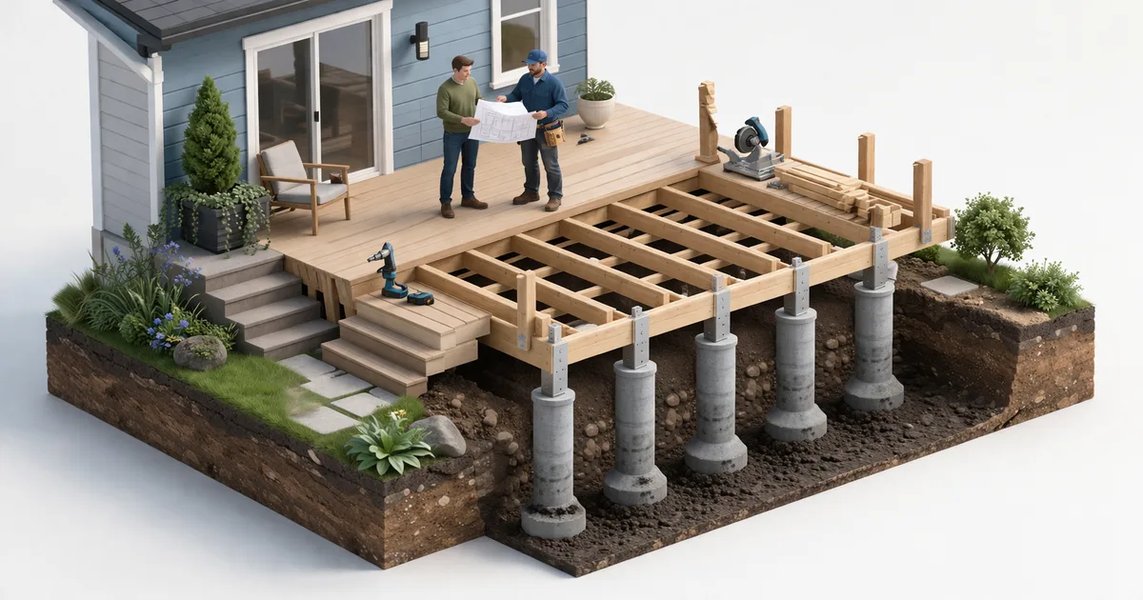
For a deck, this means your footings are the entire project. Get them right, and your deck stays level for 20 years. Get them wrong, and within two winters you'll have a deck that slopes, bounces, or has pulled away from the house.
Frost Line Depth: 4 Feet Minimum
In Ottawa, the frost line extends approximately 4 feet (1.2 metres) below grade. Your deck footings must reach below this depth. Any footing that sits above the frost line is a footing that will move when the ground freezes. The Ontario Building Code is clear on this, and so is every inspector who's ever failed a deck.
Footing Options
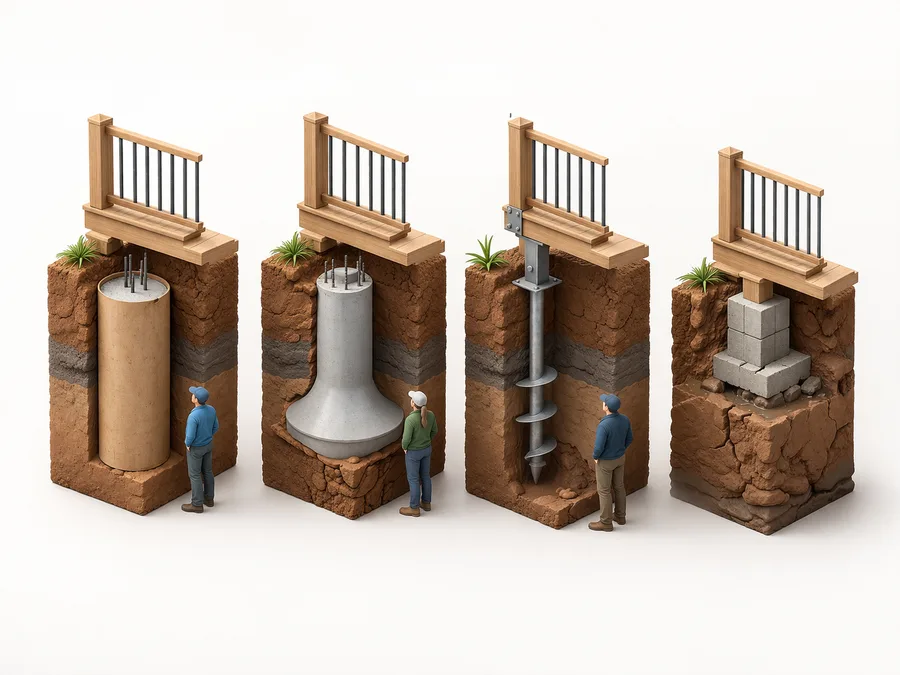
- Sonotubes with concrete: The traditional method. You dig a hole below frost line, set a cardboard tube form, pour concrete, and install a post bracket on top. Reliable and well-understood. Cost: roughly $50-$100 per footing for materials.
- Concrete piers (precast or poured): Similar concept to Sonotubes but using precast bell-bottom piers. The wider base resists frost heave better than a straight tube.
- Helical screw piles: Steel shafts with helical plates that are mechanically driven into the ground past the frost line and past the clay layer. They're gaining serious popularity in Ottawa because they're less affected by clay movement than concrete footings. The screw pile grips below the problem soil. They cost more ($150-$300 per pile installed) but they're faster to install and don't require excavation or concrete curing time.
What About Deck Blocks?
Those precast concrete deck blocks you see at building supply stores? They sit on the surface. They don't extend below the frost line. On Ottawa's clay, they shift. Every single winter. If you're building a small, freestanding, ground-level platform that you don't mind re-levelling every spring, they'll work. For anything structural or attached to your house, they're not appropriate for this climate.
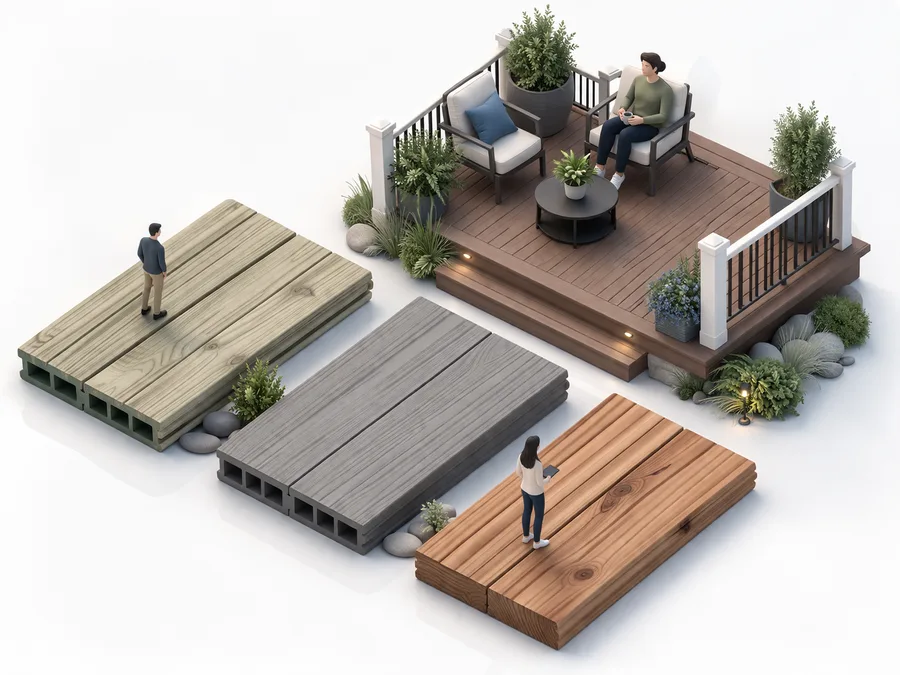
Pressure-Treated, Composite, or Cedar: Picking Your Surface
This is where most of the budget decisions happen. The framing underneath is almost always pressure-treated lumber regardless of what goes on top. The decking surface is where you choose.
Pressure-Treated Lumber
- Cost: $5,000 to $12,000 for a typical 200 sq ft deck (materials and labour)
- Lifespan: 15 to 20 years with proper maintenance
- Maintenance: Annual cleaning, staining or sealing every 2-3 years. Skip the maintenance and the wood turns grey, splinters, and deteriorates faster.
- Ottawa reality: Pressure-treated handles freeze-thaw reasonably well. It's the most forgiving material for DIY builders. The downside: it requires consistent upkeep, and it will crack and check over time. That's normal, not a defect.
Composite Decking (Trex, Fiberon, TimberTech)
- Cost: $10,000 to $20,000 for the same 200 sq ft deck
- Lifespan: 25 to 50 years depending on product line
- Maintenance: Minimal. Occasional cleaning. No staining, no sealing, no splinters.
- Ottawa reality: Composite handles Ottawa winters well, but it gets slippery when wet or icy. Some brands offer slip-resistant textures. It also gets hot in direct summer sun. Walking barefoot on dark composite decking in July can be genuinely uncomfortable. Choose lighter colours if your deck faces south.
Cedar
- Cost: $8,000 to $15,000 for 200 sq ft
- Lifespan: 15 to 20 years
- Maintenance: Moderate. Needs sealing. Ages beautifully when maintained, ages terribly when ignored.
- Ottawa reality: Cedar is gorgeous. It also splits in Ottawa's cold. The extreme temperature swings from -30C winter to +35C summer stress the wood fibres. If you go cedar, budget for the maintenance and accept that some splitting is inevitable.
Builder's perspective: Most Ottawa deck builders will tell you that composite has overtaken pressure-treated as the most requested material. The upfront cost is higher, but homeowners are doing the math on 15 years of staining vs. doing nothing, and nothing is winning.
Five Mistakes That Make Deck Builders Wince
Professional deck builders see the same problems every season. Here's what they wish homeowners knew before starting.
- Ignoring property line setbacks. You measure your yard, design the deck, buy the materials, and then discover the City's required 1.2-metre rear setback means your deck is 4 feet narrower than planned. Check the zoning first. Not after you've poured footings.
- Forgetting about snow load. Ottawa gets an average of 220 cm of snow per year. Your deck's structural design needs to account for the weight of accumulated snow, not just the weight of your barbecue and 12 guests. The Ontario Building Code specifies snow load requirements by region, and Ottawa's are higher than you might expect.
- Using deck blocks on clay soil. Covered above, but worth repeating. Deck blocks are not footings. In Ottawa's clay, they're suggestions.
- No drainage plan under the deck. Water pools under decks. In clay soil, that water has nowhere to go. It sits against your foundation, finds cracks, and enters your basement. Grading the soil under the deck to slope away from the house is cheap and prevents expensive water damage.
- Attaching to the house incorrectly. The ledger board (the piece that connects your deck to your house) needs to be properly flashed and fastened. A ledger board without flashing traps moisture between the deck and the wall. Within a few years, you've got rot in the rim joist of your house. This is the single most common structural failure point in residential decks.
What a Deck Actually Costs in Ottawa (2026 Numbers)
Real ranges based on a standard 200 sq ft deck with stairs and railing. Your mileage will vary with complexity, access, and the contractor's schedule.
- Materials only: $2,000 to $8,000 (pressure-treated on the low end, premium composite on the high end)
- Labour: $3,000 to $12,000 depending on complexity and footing requirements
- Permit: $100 to $300
- Helical piles (if chosen): $150 to $300 per pile, typically 6-12 piles for a standard deck
- Total range: $5,000 to $20,000+
The biggest variable isn't material choice. It's site conditions. A deck on flat ground with easy access costs significantly less than one on a slope, behind a house with no gate access, where every piece of lumber has to be carried through the kitchen.
Where the Money Actually Goes
Roughly 40% of your budget goes to labour, 45% to materials, and 15% to footings and permits. If a quote seems unusually cheap, ask about the footings. That's where corners get cut first, and it's the one place you absolutely cannot afford shortcuts.
When to Book and When to Build
The Ottawa deck season calendar works like this:
- February-March: Book your contractor. Get quotes, sign contracts, pull permits. This is when the good builders still have availability.
- April: Ground thaws. Footing work begins for early projects. Helical piles can go in earlier since they don't require excavation.
- May-June: Prime building season. Weather is cooperative, ground is stable, daylight hours are long.
- July-August: Peak demand. Contractors are booked solid. If you're calling now for the first time, you're likely looking at September or next year.
- September-October: Still buildable, but daylight shortens and rain becomes more frequent. Some contractors offer slight discounts for fall builds.
The people who enjoy their deck all summer are the ones who signed a contract in the winter. Think of it as placing your order before the restaurant gets busy. Same menu. Same quality. Just no wait.
Your deck is one of the best returns on outdoor living space you can get in Ottawa. The season may be short, but those evenings on the deck with the fireflies and a cold drink in July? That's the payoff. Start planning now, respect the clay, and get the footings right. Everything above them is the easy part.