
Ottawa doesn't just test your driveway. It interrogates it. Freeze. Thaw. Freeze again. Road salt. Snow plow blade. Repeat for six months. By spring, your driveway looks like it survived a minor earthquake, and honestly, the physics aren't that different.
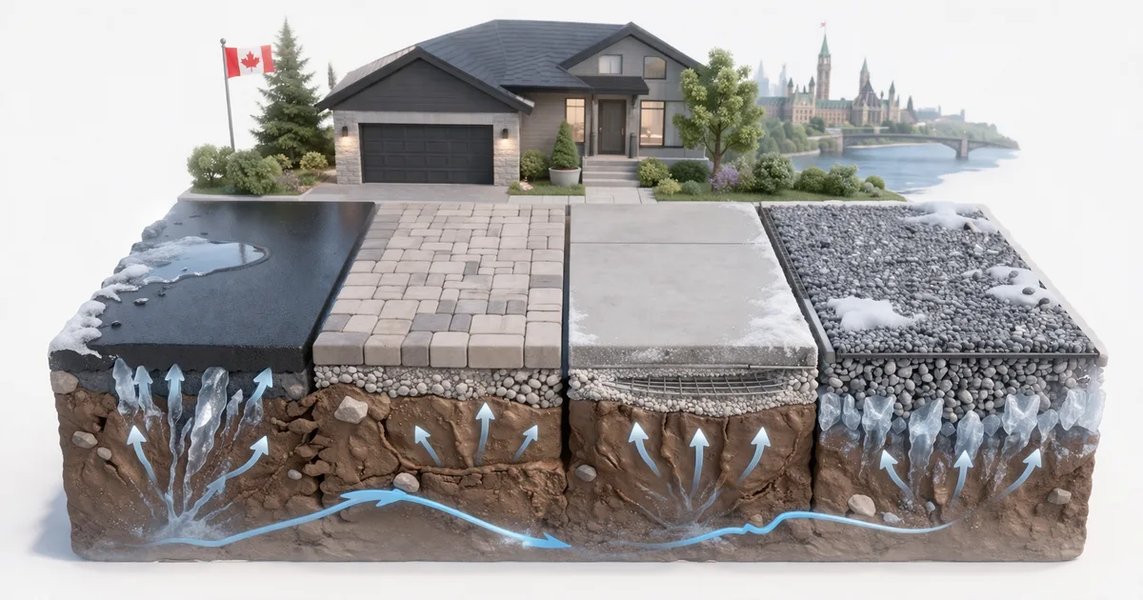
There are two types of Ottawa driveways: the ones that are cracked, and the ones that are about to be. This isn't pessimism. It's geology. Our Leda clay expands when wet, contracts when dry, and heaves when frozen. The surface material on top is just along for the ride.
But some materials ride better than others. And the difference between a driveway that lasts 8 years and one that lasts 25 almost always comes down to what's underneath the surface, not the surface itself.
Here's the full comparison for Ottawa's climate: materials, costs, lifespans, and the one factor that matters more than all of them combined.
Four Materials, One Climate: How They Compare
Asphalt
Asphalt is Ottawa's default driveway material, and for good reason. It's the best balance of cost, durability, and climate tolerance for our specific conditions.
- Cost: $4,000 to $8,000 for a standard double driveway
- Lifespan: 15 to 20 years with proper maintenance
- Why it works here: Asphalt is flexible. Unlike rigid materials, it has some give, which means it handles the micro-movements of freeze-thaw better than concrete. When it does crack (and it will), repairs are easy and cheap.
- Maintenance: Seal-coat every 2-3 years ($200 to $500 for a standard driveway). Fill cracks annually before they spread. That's it.
The trade-off: asphalt softens in extreme summer heat. Very hot days in July and August can leave it slightly tacky. Heavy vehicles parked in the same spot on a 35C day can leave impressions. This is cosmetic and temporary, but worth knowing.
Interlock (Pavers)
Interlock is the premium choice, and in Ottawa, it demands premium preparation to perform.
- Cost: $12,000 to $25,000 for a standard double driveway
- Lifespan: 25 to 30+ years
- Why it works here: Individual pavers can shift independently, which distributes freeze-thaw movement across the surface instead of concentrating stress into cracks. Damaged pavers can be individually replaced without touching the rest of the driveway. Salt and de-icing products don't damage the pavers themselves.
- The catch: Interlock is only as good as its base. On Ottawa's clay soil, you need a minimum of 12 inches (often 15-18 inches) of compacted granular base material. This base is what prevents the pavers from heaving and settling. Cheap interlock installations skimp on base depth, and within two winters you've got a driveway that looks like a topographic map.
Concrete
Concrete driveways are common in many Canadian cities. In Ottawa, they're a harder sell, and here's why.
- Cost: $6,000 to $12,000
- Lifespan: 20 to 30 years in favourable conditions, but Ottawa's conditions are not favourable
- The problem: Concrete is rigid and porous. Water penetrates the surface, freezes, expands, and spalls (chips away the top layer). Road salt and de-icing chemicals accelerate this dramatically. A new concrete driveway in Ottawa can start showing surface damage within 3-5 winters, especially if it wasn't sealed or if cheap salt was used generously.
- The verdict: Not the first choice for Ottawa's primary driveway. You'll see it on newer subdivision homes because builders can pour it quickly, but most paving professionals will steer you toward asphalt or interlock for a driveway that has to survive Ottawa's salt-and-freeze combination.
Gravel
- Cost: $1,500 to $3,000
- Lifespan: Indefinite, with annual top-ups
- Where it makes sense: Rural Ottawa properties (Carp, Navan, Manotick, North Gower, Cumberland). Longer driveways where paving costs would be astronomical. Hobby farms. Seasonal properties.
- Maintenance: Annual grading and top-up with fresh gravel ($200-$500). Spring is the worst for gravel driveways because freeze-thaw churns the surface and snow plows scrape gravel into the lawn. Budget for replenishing what the plow stole every April.
The Part You Can't See Is the Part That Matters
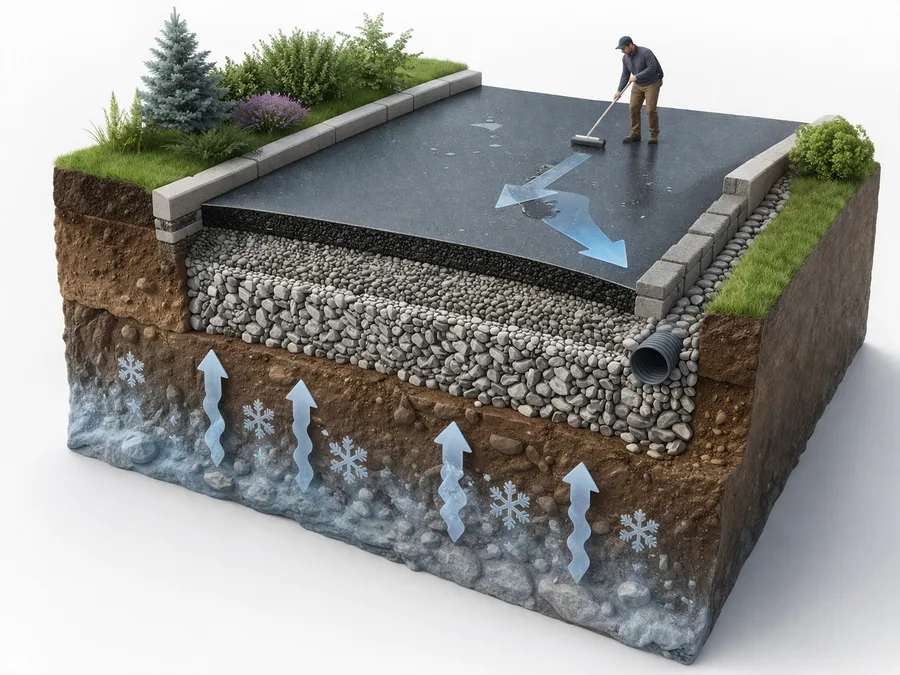
This is the single most important section in this article. You can choose the most expensive surface material available and it will still fail on Ottawa's clay if the granular base underneath is inadequate.
Leda clay doesn't drain. Water sits in it, expands when it freezes, and pushes up whatever is on top. A proper granular base creates a stable layer between the clay and your driveway surface. It drains water away, distributes load, and absorbs the minor movements of the soil below without transferring them to the surface above.
Base Depth Guidelines for Ottawa
- Asphalt: 8 to 12 inches of compacted granular base (Granular A and Granular B)
- Interlock: 12 to 18 inches, plus 1 inch of bedding sand
- Concrete: 8 to 12 inches, with proper expansion joints
A contractor who quotes significantly less than competitors is often saving money on base material. Four inches of base instead of twelve. It looks fine on installation day. Two winters later, you understand why it was cheap.
When evaluating quotes, ask specifically: how deep is the granular base? What type of granular are you using? Will you compact in lifts? If the contractor can't answer these questions, or gives vague answers, that's your signal to get another quote.
Seal-Coating: Necessary Maintenance or Snake Oil?
For asphalt driveways, seal-coating is legitimate maintenance. The coating fills surface micro-cracks, prevents water penetration, and protects against UV damage and the oxidation that turns asphalt from black to grey. Applied every 2-3 years, it genuinely extends the life of your driveway.
Here's the problem: seal-coating has attracted the highest concentration of scam operators in the home services industry. The classic approach goes like this: a truck with no visible business name pulls up while you're mowing the lawn. The driver tells you they just finished a job nearby and have leftover material they'd hate to waste. They can do your driveway right now for a great price. Cash only.
What you get: a thin coat of diluted product that looks shiny for two weeks and peels off by October. Legitimate seal-coating products are expensive, and proper application requires cleaning the surface, filling cracks, and applying two coats with adequate drying time between them.
How to Avoid the Scam
- Never hire someone who comes to your door. Reputable seal-coating companies have enough scheduled work. They don't need to drive around looking for customers.
- Get a written quote that specifies the product brand, number of coats, and surface preparation included.
- Check reviews and references. A company that's been operating in Ottawa for multiple seasons has a track record you can verify.
- Expect to pay $200-$500 for a standard double driveway. If the quote is $99 or "whatever you think is fair," you're not getting seal-coating. You're getting a rinse.
Drainage: Where the Water Goes Determines How Long Your Driveway Lasts
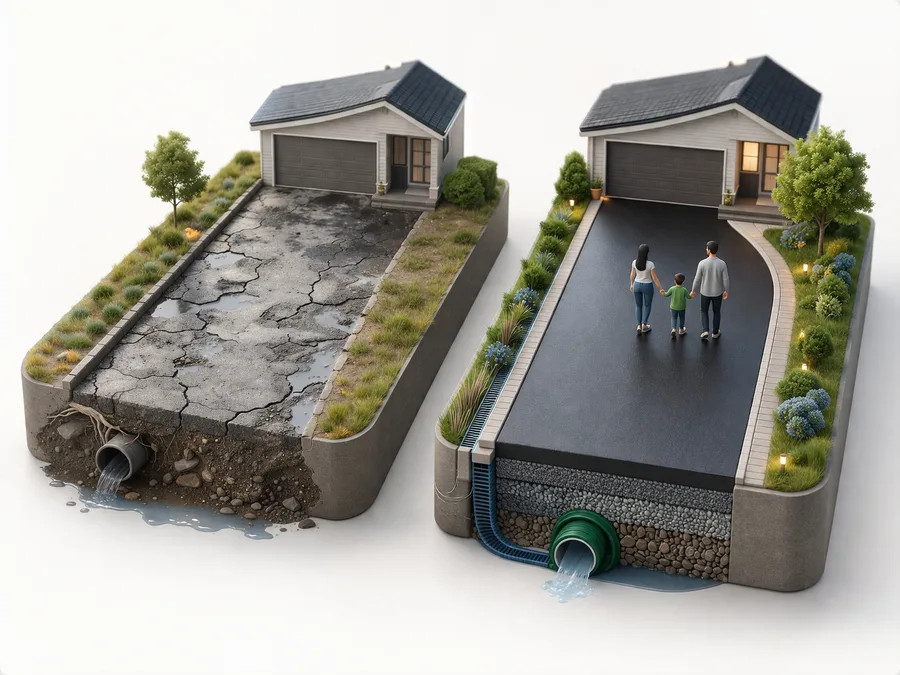
On clay soil, water that doesn't drain away pools. Pooling water infiltrates surfaces, freezes, and breaks things. Every driveway needs to slope away from the house and toward the street. The standard grade is a 2% slope: roughly a quarter inch of drop per foot of length.
Common drainage problems in Ottawa:
- Driveway settling near the garage: Water pools at the garage door instead of flowing to the street. This sends water into the garage and, eventually, the basement.
- No swale between driveway and lawn: Meltwater runs across the driveway surface, carrying salt and grit that accelerate surface wear.
- Downspout discharge onto the driveway: Concentrated water flow erodes asphalt edges and undermines interlock pavers. Extend downspouts to discharge onto the lawn or into a rain garden.
If your existing driveway has standing water after rain, a resurface alone won't fix it. The grading needs to be corrected during the rebuild, or you'll have the same pooling problem on a more expensive surface.
Winter Damage: What Your Plow and Your Salt Are Actually Doing
Ottawa's winter maintenance habits cause as much driveway damage as the weather itself.
Salt and De-Icers
- On asphalt: Standard road salt is fine. Asphalt is chemically resistant to sodium chloride.
- On concrete: Salt is devastating. It accelerates the freeze-thaw spalling cycle and can cause visible surface damage in a single season. If you have a concrete driveway, use sand for traction or calcium magnesium acetate (CMA) as a de-icer. Never regular salt.
- On interlock: Pavers handle salt well. The polymeric sand between joints can degrade faster with heavy salt use, requiring more frequent re-sanding (every 2-3 years instead of 3-5).
Snow Plows
Metal plow blades scrape driveway surfaces. On asphalt, this causes minor surface wear but rarely structural damage. On interlock, an aggressive plow can catch raised paver edges and pop them out of place. If you have an interlock driveway, make sure your plow operator sets the blade to ride slightly above the surface (shoes up) and accept a thin layer of packed snow rather than a bare surface.
On gravel, plows are the enemy. Every pass takes a layer of gravel with it. Mark your driveway edges with stakes so the operator knows where gravel ends and lawn begins.
Repair, Resurface, or Replace: When Each Makes Sense
Not every crack means a new driveway. Here's how to read the damage.
Patch and Crack Fill (Cheapest)
Individual cracks less than half an inch wide: fill with rubberized asphalt crack filler. Cost: $50 to $200 DIY, $300 to $600 professional. Small potholes: cold patch asphalt from the hardware store is a temporary fix that lasts 1-2 seasons.
Resurfacing (Mid-Range)
When the surface has widespread minor cracking but the base is still solid, a new layer of asphalt (1.5-2 inches) can be applied over the existing surface. Cost: $2,000 to $4,000. This works when the existing driveway is structurally sound but cosmetically worn.
Full Replacement (Most Expensive, Sometimes Necessary)
When you see alligator cracking (a network of interconnected cracks that looks like scales), large areas of settlement, or sections where the surface has broken into pieces, the base has failed. No amount of patching or resurfacing will fix a failed base. It needs to come out, and a new base needs to go in.
The 30% rule: if patches and crack fills cover more than 30% of your driveway surface, you've reached the point where replacement is more cost-effective than continued maintenance. You're spending money to delay the inevitable, and the result still looks like a patchwork quilt.
Booking and Timing: The Asphalt Season
Asphalt plants in Ottawa shut down from approximately November through April. No asphalt is produced, which means no asphalt driveways are installed during this period. The paving season runs from May through October, with June through September being the busiest months.
- Best time to book: February through April, for installation in May or June
- Best time for price: September and October, when demand drops and some contractors offer end-of-season pricing
- Worst time to call: June, expecting July installation. You'll join a long queue.
Interlock can be installed later in the season than asphalt since it doesn't require hot-mix material, but base preparation still needs unfrozen ground. Most interlock installers wrap up by late October.
Your driveway takes more abuse per square foot than any other surface on your property. It handles every car, every delivery truck, every snow plow blade, and every freeze-thaw cycle Ottawa can throw at it. The right material, the right base depth, and the right maintenance schedule are the difference between a surface that lasts two decades and one that falls apart in five. Invest in what's underneath, maintain what's on top, and stay away from anyone offering seal-coating out of the back of an unmarked truck.