
July in Ottawa Is a Character Test
July in Ottawa is a character test. The humidex hits 45 and your house becomes a slow cooker. Your options are: three box fans and a prayer, a window unit that sounds like a helicopter landing, or an actual air conditioning system designed for this climate.
If you've survived an Ottawa summer without AC, you know the drill. The bedroom hits 30 degrees by midnight. You open every window and the air doesn't move. The dog relocates to the basement tiles. You consider sleeping in the car with the engine running because at least the car has climate control.
Ottawa isn't Miami, but for about 6 to 8 weeks each summer, the combination of heat and humidity can make homes genuinely uncomfortable and, for vulnerable people like the elderly and very young, potentially dangerous. Environment Canada issued 14 heat warnings for the Ottawa region in 2023. The trend is heading in one direction.
So if you're thinking about adding or upgrading air conditioning, now is the time to understand your options, their costs, and the one scheduling mistake that almost everyone makes.
Central Air Conditioning: The Standard
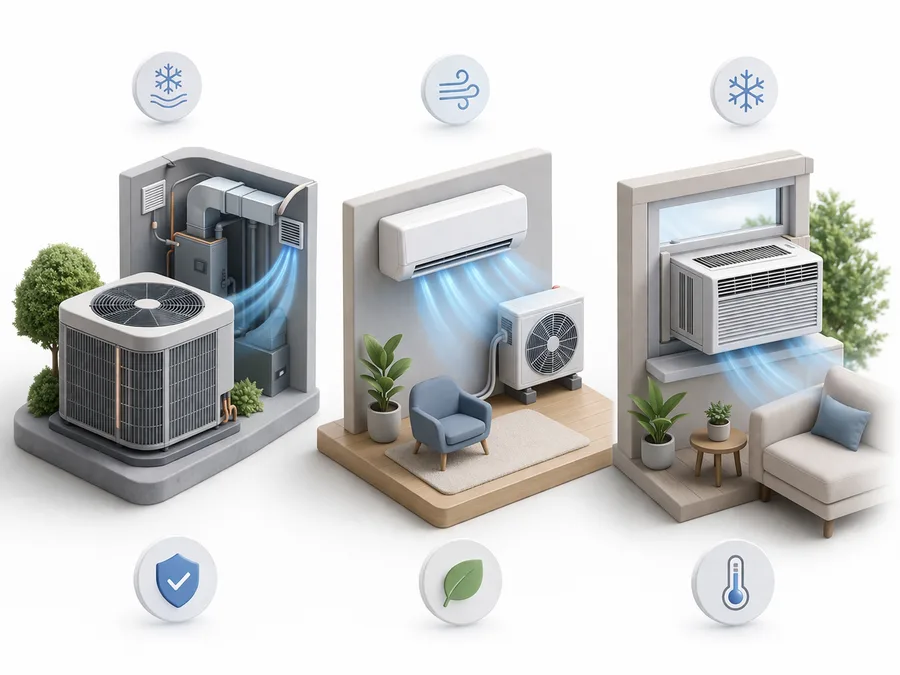
Central AC is the most common cooling system in Ottawa homes built after 1990. It uses an outdoor compressor unit, an indoor evaporator coil mounted on your furnace, and your existing ductwork to distribute cooled air throughout the house.
How It Works
Refrigerant circulates between the outdoor unit (which dumps heat outside) and the indoor coil (which absorbs heat from the air passing over it). Your furnace blower pushes house air across the cold coil, removing both heat and moisture, then distributes the cooled, dehumidified air through your duct system.
The dehumidification is important in Ottawa. It's not just the heat that makes summers miserable here. It's the humidity. A properly sized central AC system drops indoor relative humidity from the 60 to 70 percent range down to a comfortable 40 to 50 percent.
Costs
For a home that already has ductwork and a compatible furnace, a new central AC installation in Ottawa runs $4,500 to $8,000. That includes the outdoor unit, indoor coil, refrigerant line set, electrical connection, thermostat, and commissioning.
Higher-efficiency units (higher SEER2 ratings) cost more upfront but use less electricity per cooling hour. A 16 SEER2 unit costs roughly 20 percent less to operate than a 14 SEER2 unit. Over 15 to 20 years, the operating savings often exceed the price difference.
The Critical Requirement
Central AC requires ductwork. If your home has a furnace with ducts, you're set. If it doesn't (baseboard electric heat, radiator systems, or no heating ducts at all), central AC isn't a simple add. Installing ductwork in an existing home costs $10,000 to $20,000+ and is incredibly disruptive in a finished house. For homes without ducts, a ductless system is almost always the better path.
Sizing Matters (A Lot)
This is where cheap installations go wrong. A central AC system must be sized correctly for your home's square footage, insulation level, window area, and orientation. An HVAC contractor should perform a Manual J heat load calculation, not just eyeball it based on square footage.
- Undersized unit: Runs constantly, never reaches the thermostat setting on the hottest days, electricity bills through the roof, shortened compressor life from continuous operation.
- Oversized unit: Cools the house too quickly, shuts off before it can properly dehumidify. You end up with a house that hits 22 degrees but feels clammy because the humidity is still 65 percent. Short cycling also wears out the compressor faster.
In Ottawa's humid summers, proper sizing is even more critical than in dry climates. An oversized system that short-cycles in a dry climate is uncomfortable. An oversized system that short-cycles in Ottawa creates a cold, damp house that can develop mould problems. Yes, your AC can actually cause mould if it's the wrong size.
Ductless Mini-Splits: The Flexible Alternative
Ductless mini-split heat pumps have exploded in popularity in Ottawa over the past five years, and for good reason. They solve problems that central AC can't.
How They Work
An outdoor compressor connects to one or more indoor wall-mounted heads via a small refrigerant line (3-inch hole through the wall, no ductwork). Each indoor head cools (and heats) the room it's in, independently controlled by its own thermostat or remote.
Why Ottawa Homeowners Love Them
- No ductwork required: Perfect for homes with baseboard heat, radiator systems, or older homes where installing ducts is impractical
- Heat AND cool: A mini-split is a heat pump. It cools in summer and heats efficiently down to about minus 15 to minus 25 (depending on the model). Some Ottawa homeowners use them as their primary heat source for shoulder seasons, supplementing their furnace only during the coldest weeks.
- Zone control: Each head operates independently. Cool the bedrooms at night without cooling the empty living room. This alone can reduce cooling costs by 20 to 30 percent compared to central AC cooling the entire house.
- Whisper quiet: A modern mini-split indoor head runs at about 20 to 25 decibels. That's quieter than a library. Compared to a window unit at 50+ decibels, it's a different world.
- No window blockage: The indoor head mounts high on a wall. You keep all your windows.
Costs
- Single-zone system (one outdoor unit, one indoor head): $3,500 to $6,000 installed
- Multi-zone system (one outdoor unit, 2 to 5 indoor heads): $10,000 to $18,000 installed
Multi-zone systems are more expensive upfront but provide whole-home coverage without ductwork. For a 3-bedroom Ottawa home without ducts, a 4-head mini-split system is typically the most cost-effective path to proper AC.
Window Units: The Budget Option
A window AC unit in a century home is the residential equivalent of duct tape. It works, technically, but nobody's proud of it.
The Reality
Window units are cheap ($200 to $600 per unit), available immediately, and require no installation beyond muscling them into the window frame. For a renter or someone who needs cooling for one room on a tight budget, they're a valid choice.
The Downsides
- Noise: 50 to 60 decibels. You'll hear it cycling on and off all night.
- Blocked window: The unit occupies an entire window, reducing natural light and ventilation options.
- Security: A propped-open window is an invitation. Some units leave gaps that can't be fully secured.
- Efficiency: Window units are significantly less efficient than central AC or mini-splits. Running three window units all summer costs more in electricity than operating a single central AC system.
- Dehumidification: Marginal at best. Window units cool the air but struggle to remove humidity effectively, which is exactly what makes Ottawa summers so uncomfortable.
If you're spending more than $1,500 on window units across multiple rooms, you're approaching the down payment on a ductless mini-split that will outperform them in every measurable way for the next 15 to 20 years.
Timing: The Mistake Everyone Makes
The HVAC industry in Ottawa has a rhythm, and understanding it saves you money and misery.
The Rush
Every year, the first hot week in late May or early June triggers a wave of panicked calls to HVAC companies. By mid-June, most reputable installers are booked 3 to 4 weeks out. By mid-July, you're looking at 4 to 6 weeks, and emergency installations (if you can get one) cost 20 to 30 percent more than a scheduled install.
Meanwhile, the hottest weeks of July and August are exactly when you need the system most. If you call in July, your AC gets installed in August, and summer is mostly over.
The Smart Move
Book your AC installation in March or April. Yes, when there's still snow on the ground. This is when HVAC companies have open schedules, sometimes offer off-season pricing, and can do the work at their pace instead of rushing between emergency calls.
You'll have your system tested and running before the first hot day. No panic. No premium pricing. No sweating through three weeks of Ottawa humidex while waiting for an installation slot.
Timing tip: If you're reading this in June or later and don't have AC, don't wait for next March. Start the conversation with HVAC companies now. Even if the install happens late this summer, you'll be ready for next year. And many companies will schedule a fall install at better pricing than a summer emergency.
Cooling Heritage Homes: Glebe, Sandy Hill, and Centretown
If you own a century home in one of Ottawa's older neighbourhoods, your cooling options are shaped by your building's bones.
Why Central AC Is Usually Not the Answer
Most pre-1940 Ottawa homes have no ductwork. They were heated by radiators (hot water or steam) or gravity-fed floor registers from a basement furnace. Adding conventional ductwork to a 120-year-old Glebe home means running large rectangular ducts through finished walls, floors, and ceilings. The structural modifications, drywall repair, and aesthetic compromises make it a $10,000 to $20,000+ project that most heritage homeowners find unacceptable.
Mini-Splits Are Usually the Play
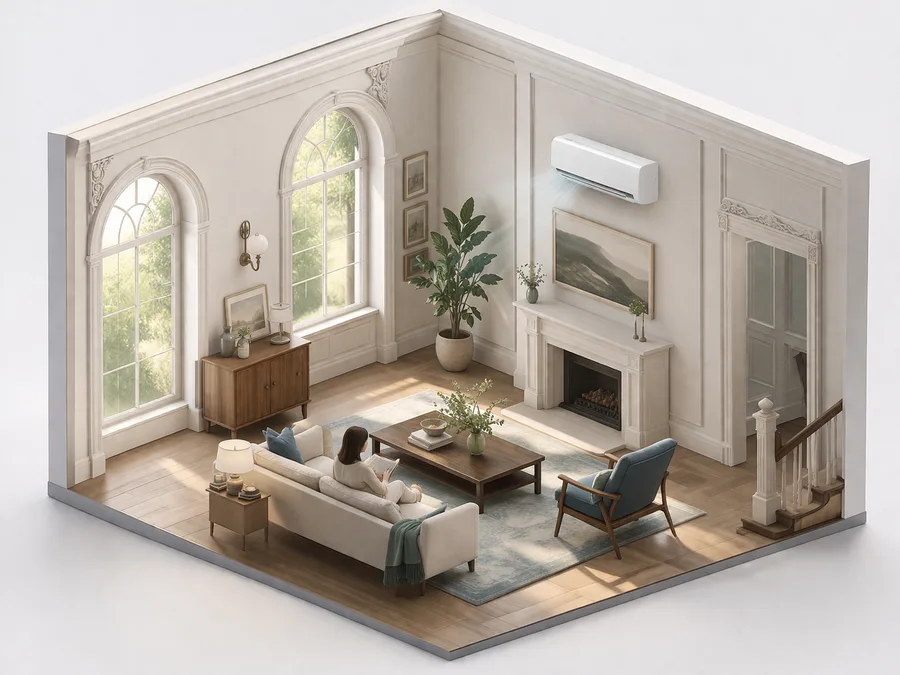
A ductless mini-split requires only a 3-inch hole through an exterior wall for the refrigerant lines. The indoor head mounts high on a wall and the outdoor compressor sits on a pad or wall bracket. Minimal structural impact, no lost closet space to duct chases, and no ceiling drops.
For a typical Sandy Hill Victorian or Glebe semi-detached, a 3 to 4 head multi-zone system covers the main living areas and bedrooms at $12,000 to $16,000 installed. That's often less than ductwork alone would cost.
Heritage Considerations
If your home is in a Heritage Conservation District, the outdoor unit placement matters. HCD guidelines may restrict visible equipment on street-facing facades. Talk to your HVAC contractor about side-yard or rear-yard placement, and check with the City's heritage planning office before installation if you're in an HCD zone.
Indoor heads in heritage homes also benefit from thoughtful placement. A white unit high on a wall in a room with 10-foot ceilings and crown moulding is barely noticeable. The same unit at eye level in a room with 8-foot ceilings and detailed trim is an eyesore. Placement matters.
Keeping Your System Running Right
Every AC system, regardless of type, needs basic maintenance. Skip it and you'll pay more in electricity, get less cooling, and shorten the system's lifespan.
Filters
Central AC: Replace or clean the furnace filter every 1 to 3 months during cooling season. A dirty filter restricts airflow, forces the system to work harder, and reduces both efficiency and comfort. This is the single most impactful maintenance task, and it takes 60 seconds.
Mini-splits: Clean the washable filter in each indoor head every 2 to 4 weeks during heavy use. Pop the front panel, slide the filter out, rinse under warm water, let it dry, and reinstall. Ignore this and the head's airflow drops noticeably within a month.
Outdoor Unit
Keep the outdoor compressor clear of debris. Trim vegetation to maintain at least 2 feet of clearance on all sides. In fall, clear leaves from the unit. In winter, if you have a heat pump that runs year-round, keep snow from piling against it.
Annual Professional Service
A yearly tune-up from an HVAC technician ($100 to $200) includes checking refrigerant levels, cleaning the indoor coil, inspecting electrical connections, and verifying the system is operating at design efficiency. Best scheduled in spring, before the cooling season begins.
AC is no longer a luxury in Ottawa. It's a practical necessity for most households during July and August. The question isn't whether to get it, it's which system matches your home, your budget, and your tolerance for planning ahead.
If your home has ducts and you want whole-house cooling, central AC is the proven standard. If you're in a heritage home without ductwork, mini-splits are the clear winner. If you need cooling now and money is tight, a window unit keeps you alive through summer while you plan something better.
Just book it before June. Your future self, the one sitting comfortably at 22 degrees while the neighbourhood melts, will appreciate the foresight.