
The Sound You Never Want to Hear
The sound of water where there shouldn't be water is one of the worst sounds a homeowner can hear. It might be a gentle drip behind the bathroom wall. It might be a rushing noise in the basement. Either way, what you do in the next 24 hours will determine whether this is a $2,000 repair or a $30,000 renovation.
Water damage is the most common home insurance claim in Canada. Not fire, not theft, not wind. Water. And Ottawa faces a particular concentration of water risks: burst pipes in winter, spring flooding from the Ottawa River and snowmelt, summer storm sewer backup, and appliance failures that don't care what season it is.
Water has exactly one hobby: finding the lowest point in your house. It's remarkably good at it.
This guide covers what to do immediately, how insurance actually works for water claims, what professional restoration involves, and how to prevent the next incident. In that order, because that's the order you'll need it.
The First 24 Hours: What to Do Right Now
If you're reading this with water currently in your house, here are the steps in order. Don't skip any of them.

1. Stop the Source
For a burst pipe: find your main water shut-off valve and turn it off. Every homeowner should know where this is before an emergency. In most Ottawa homes, it's in the basement, near the front wall where the water line enters from the street. Turn it clockwise until it stops.
For flooding from outside: you can't stop the source, but you can control where water goes. If your sump pump is running, make sure the discharge line is clear and pointing away from the foundation. If it's not running, check the breaker.
For any flooding: if water is near electrical outlets, appliances, or your electrical panel, turn off the electricity to the affected area at the breaker panel. If you can't reach the panel safely (standing water between you and it), call the fire department or Hydro Ottawa. Don't walk through standing water to reach a live electrical panel.
2. Document Everything Before Cleanup
This step feels counterintuitive when your basement is flooding, but it's critical for your insurance claim. Take photos and video of the water level, the source (if visible), and every affected item and surface. Do this before you start removing water or moving belongings.
Insurance adjusters want to see the damage as it happened, not after you've cleaned up. A 3-minute video walkthrough of the affected area can be worth thousands of dollars in claim value.
3. Call Your Insurance Company
Most home insurers have 24-hour claims lines. Call as soon as the immediate safety steps are done. Report the damage, describe the source, and ask what they need from you. Some insurers will dispatch their own preferred restoration company. Others will let you choose.
Important: your insurer may ask you to take "reasonable steps to mitigate damage." This means you're expected to do what you can to prevent further damage (extracting water, moving undamaged items away from the water). It does not mean they expect you to handle the full restoration yourself.
4. Extract Standing Water
If you have a wet/dry vacuum, use it. If you have a sump pump or utility pump, deploy it. For significant standing water (several inches or more), a restoration company will bring commercial extraction equipment that handles the job far faster than consumer tools.
5. Start Drying Immediately
Mould can begin growing within 24 to 48 hours in warm, damp conditions. Every hour of drying time matters.
- Run fans to circulate air across wet surfaces.
- Run a dehumidifier (or multiple dehumidifiers) in the affected area.
- Open windows if the outside air is dry and warm. In an Ottawa winter, this isn't an option, but dehumidifiers and fans still work.
- Turn up the heat in the affected area to accelerate evaporation.
6. Remove What Can't Be Saved
Some materials absorb water and can't be effectively dried. Carpet padding (the foam underneath carpet) is almost always a loss once it's soaked. Drywall that was submerged below the waterline will need to be cut out. Particleboard furniture that absorbed water will swell and delaminate permanently.
Hardwood furniture, solid wood, and most hard-surface flooring can usually be saved if dried quickly. When in doubt, leave it for the restoration company to assess.
7. Call a Professional If...
Call a professional restoration company if any of these apply:
- The affected area exceeds 10 square feet.
- The water is contaminated (sewer backup, river water, or water with visible debris or odour).
- You can smell mould or see visible mould growth.
- Water has been standing for more than 24 hours.
- The water affected structural elements (subfloor, wall cavities, insulation).
Water Categories: Why the Source Matters for Insurance
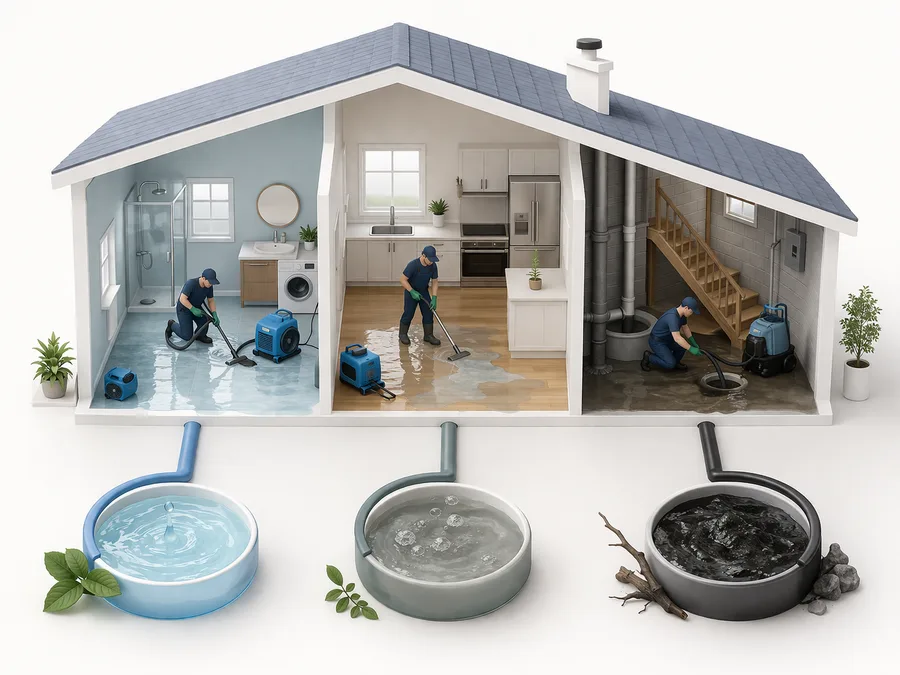
Not all water damage is created equal, and your insurance coverage depends heavily on where the water came from. The restoration industry classifies water damage into three categories, and insurance policies treat each one differently.
Category 1: Clean Water
Water from a sanitary source: burst supply pipe, overflowing sink or bathtub (without sewage), or a broken water heater. This is the most straightforward to clean up and the most reliably covered by standard home insurance. The water itself poses no health risk.
Category 2: Grey Water
Water with some contamination: dishwasher overflow, washing machine discharge, sump pump failure. Contains some biological or chemical contaminants that can cause illness with exposure. Usually covered by standard policies, but the cleanup process is more involved, requiring antimicrobial treatment of affected surfaces.
Category 3: Black Water
Severely contaminated water: sewer backup, toilet overflow with solids, river or creek flooding. Contains pathogens, chemicals, and biological contaminants that pose serious health risks. This is where insurance coverage gets complicated.
Black water from sewer backup typically requires a separate endorsement (rider) on your home insurance policy. In Ottawa, this endorsement costs $50 to $300 per year. After the major flooding events in 2017 and 2019, some Ottawa-area properties, particularly in Constance Bay, parts of Cumberland, and Britannia, face higher premiums or outright exclusions for flood-related coverage.
Overland flooding (water entering from ground level due to rising water tables or river overflow) became more widely available as an insurance product after 2016, but high-risk zones may still face exclusions. If you live near the Ottawa River or in a known flood plain, check your policy now. Not after the water arrives.
Insurance Reality in Ottawa: What's Covered and What Isn't
The most important thing to understand about water damage insurance is this: policies cover sudden and accidental events. That phrase does a lot of heavy lifting.
Typically Covered
- Burst pipe due to freezing (sudden, accidental)
- Water heater tank failure (sudden, accidental)
- Appliance supply line rupture (sudden, accidental)
- Sewer backup (with endorsement)
- Overland flood (with endorsement, where available)
Typically NOT Covered
- Gradual damage: A slow leak behind a wall that's been dripping for months is not sudden. By the time you discover it, the damage has been accumulating for a long time, and insurers classify this as a maintenance issue. This is one of the most common claim denials in Canada.
- Lack of maintenance: A sump pump that failed because you never tested or maintained it may not be covered. Insurance expects you to maintain your home's systems.
- Unpermitted plumbing work: If water damage originates from plumbing that was installed without a permit, your insurer may deny the claim. Another reason permits matter.
- Vacant home: Most policies have a vacancy clause. If your home has been unoccupied for more than 30 days (common during extended travel or between tenants), water damage coverage may be voided.
The 2022 derecho that tore across Ottawa caused widespread water and structural damage, with insurance claims in the hundreds of millions. Many homeowners discovered coverage gaps after the event. Wind damage was covered. The water damage that followed the wind damage sometimes wasn't, depending on the source and policy wording.
Read your policy. Then call your broker and ask them to explain what "water damage" means in your specific coverage. The time to learn this is on a dry Tuesday afternoon, not while standing in three inches of basement water.
What Professional Restoration Actually Involves
A professional water damage restoration follows a specific process, and understanding it helps you evaluate whether you're getting quality work.
Assessment and Moisture Mapping
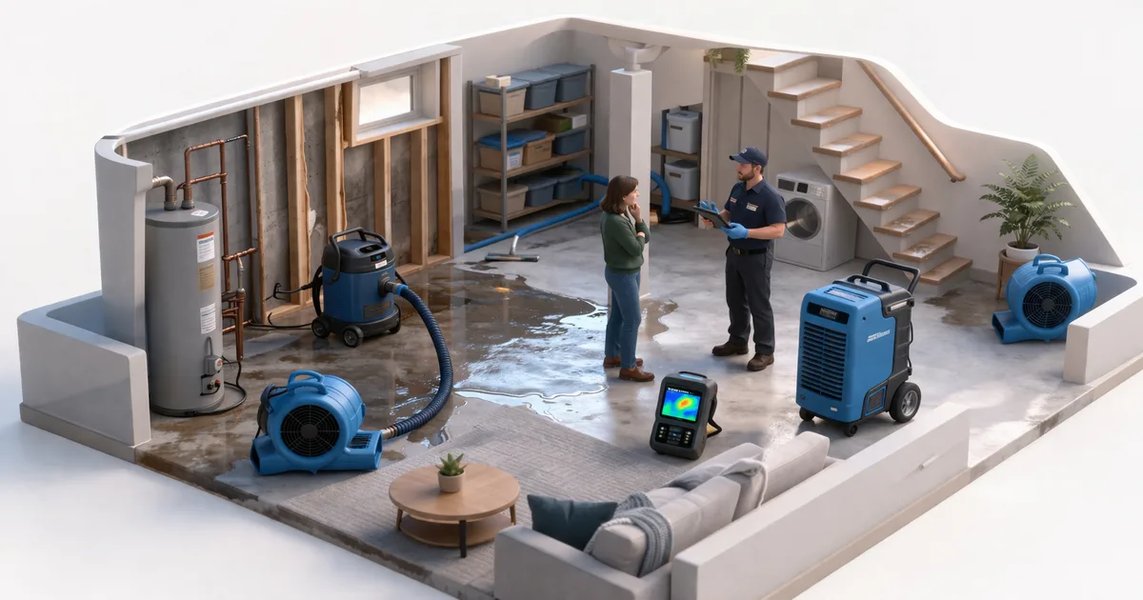
Restoration technicians use moisture meters and thermal imaging to map exactly where water has migrated. Water doesn't stay where it lands. It wicks into drywall, runs along floor joists, and pools behind vapour barriers. A visual inspection misses most of the affected area. Professional assessment finds it.
Water Extraction
Commercial truck-mounted extractors remove standing water far faster than a shop vacuum. For a typical basement flood, professional extraction can remove water in hours that would take you days with consumer equipment.
Structural Drying
This is the part that takes time. Industrial air movers (not regular fans) and commercial dehumidifiers run continuously for 3 to 5 days, sometimes longer. The goal is to bring moisture levels in walls, floors, and structural elements back to normal. Technicians take daily moisture readings to track progress.
This phase is noisy and inconvenient. Multiple powerful fans running 24 hours a day isn't pleasant. But cutting this phase short is how you get mould six months later.
Mould Prevention Treatment
After drying, affected surfaces are treated with antimicrobial solutions to prevent mould growth. Any materials that couldn't be dried adequately (drywall, insulation, carpet padding) are removed and disposed of.
Rebuild
The final phase: replacing removed drywall, reinstalling flooring, repainting, and restoring the space to pre-damage condition. This is a separate process from restoration and may involve different contractors.
Typical Costs
Costs vary enormously based on the extent of damage, water category, and affected materials:
- Small to moderate basement flood (Category 1, under 500 sq ft): $3,000 to $10,000 for extraction, drying, and basic rebuild.
- Severe basement flood (Category 2 or 3, finished basement, full footprint): $15,000 to $50,000 or more, including complete drywall removal, mould treatment, and full rebuild.
- Multi-floor damage (burst pipe on upper floor affecting ceilings, walls, and floors below): $20,000 to $75,000+ depending on the scope.
Prevention: The Cheapest Fix Is the One You Do Before the Flood
Every water damage restoration company will tell you the same thing: most incidents are preventable. Not all, but most.
Know Your Shut-off Valve
Find your main water shut-off valve right now. Not during a crisis. Now. In most Ottawa homes, it's a round gate valve or quarter-turn ball valve in the basement near the front foundation wall. Test it annually to make sure it actually turns. Valves that haven't been operated in years can seize, which means you can't stop the flow when you need to.
Install Water Leak Detectors
Small battery-powered sensors ($20 to $50 each) that sit on the floor near potential leak sources and alarm when they detect moisture. Place them:
- Next to your water heater
- Behind your washing machine
- Under kitchen and bathroom sinks
- Near your sump pump pit
- Anywhere you've had a previous leak
Smart versions ($50 to $150) connect to your phone and alert you when you're away from home. When a pipe bursts while you're at work, the difference between 30 minutes of water flow and 8 hours of water flow is the difference between a repair and a gut renovation.
Maintain Your Sump Pump
Test your sump pump every three months by pouring a bucket of water into the pit and verifying the pump activates. Check that the discharge line is clear and directed away from the foundation. If your pump is more than 7 years old, consider replacing it before it fails.
A battery backup sump pump ($300 to $600 installed) runs when the power goes out, which is exactly when you're most likely to need it. Spring storms that bring heavy rain also bring power outages, and your primary sump pump is useless without electricity.
Install a Backwater Valve
A backwater valve prevents sewer water from flowing back into your home through the drain system. Cost: $2,000 to $5,000 installed. The City of Ottawa offers a rebate of up to $7,000 through its Protective Plumbing Program, which can cover most or all of the installation cost.
If you've ever had sewer backup, or if your neighbours have, this is the single best investment you can make. A $4,000 valve that prevents a $25,000 sewer backup claim is the kind of math that doesn't need a calculator.
Don't Ignore Small Leaks
A dripping pipe under the sink costs $200 to fix today. Left alone for six months, that slow drip saturates the cabinet floor, spreads to the subfloor, and creates a mould colony behind the wall that costs $15,000 to remediate. Small leaks are not small problems waiting for a convenient time. They're large problems on a timer.
The same applies to water stains on ceilings, musty smells in closets, and that "little bit of moisture" in the basement corner you've been meaning to look at. Every one of those is water telling you where it is. Listen to it.
Before the Next One
Water damage is stressful, expensive, and disruptive. But the recovery process is well understood, the restoration industry is professional and experienced, and insurance covers most sudden events when you have the right policy in place.
The actions that matter most are the ones you take before anything goes wrong: knowing your shut-off valve, maintaining your sump pump, installing leak detectors, and reading your insurance policy. These are afternoon tasks, not renovation projects. And they're the difference between a manageable inconvenience and a catastrophic loss.
If you're currently dealing with water damage, follow the first 24-hour steps in order. Stop the source, document, call insurance, extract, dry. Don't try to skip ahead to the rebuild before the drying is complete. The restoration timeline exists for a reason, and cutting it short creates worse problems down the road.
And once it's over, put the prevention measures in place so the next time water tries to find the lowest point in your house, it finds a sensor, a valve, or a pump waiting for it instead of an unfinished basement and an expired insurance endorsement.