
Your House Is Having a Quiet Panic Attack
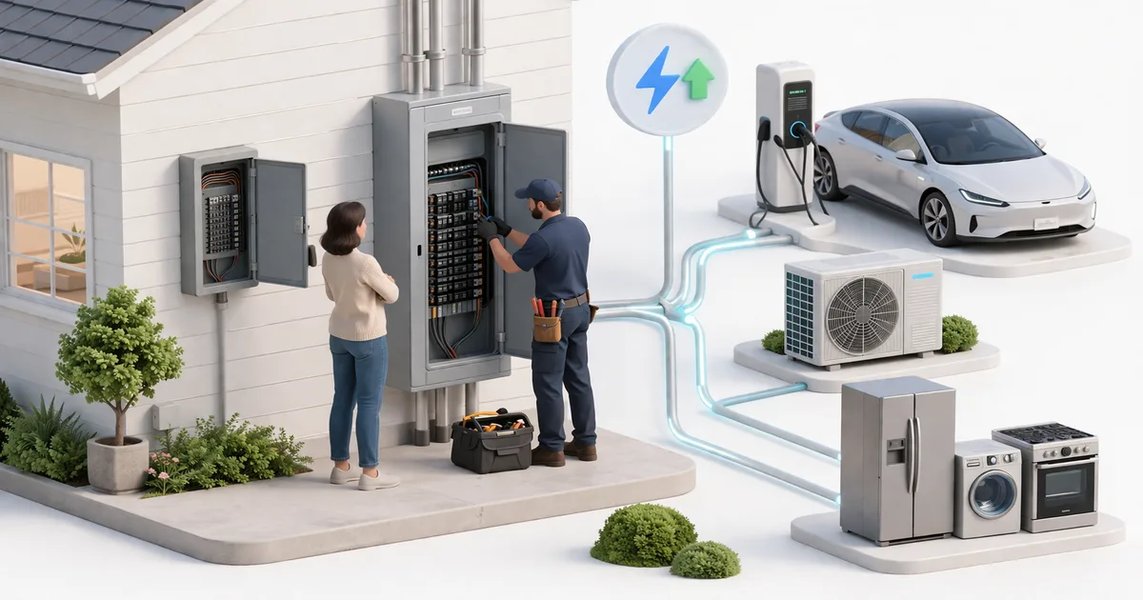
Your house was built in 1975. Back then, the heaviest electrical load was a hair dryer and a colour TV. Now you want to charge an electric car in the garage, run a heat pump, and your kitchen has more computing power than the Apollo program. Your electrical panel is having a quiet panic attack.
Across Ottawa, the same scenario is playing out in thousands of homes. Homeowners are adopting new technology faster than their electrical infrastructure can handle it. EV chargers alone are a 40 to 50 amp load. Heat pumps need dedicated 30 to 60 amp circuits. Induction cooktops draw 40 to 50 amps. Add it up and you're asking a 100-amp panel to deliver 200 amps of capacity.
An electrical panel is like a traffic intersection. A 100-amp panel is a two-lane road. You just added an EV charger, a heat pump, and an induction cooktop. That's rush hour on a country road.
Something has to give. Usually it's a breaker. Sometimes it's your patience. Occasionally, in older panels with deteriorating components, it's your safety.
Signs Your Panel Is Maxed Out
Electrical panels don't fail dramatically in most cases. They fail in small, annoying ways that gradually get worse.
Breakers Tripping Under Load
If running the microwave and the toaster at the same time trips a breaker, or if the basement breaker trips when your dehumidifier and sump pump run simultaneously, you've got circuits at or beyond their rated capacity. Individual breaker trips mean that circuit is overloaded. Frequent trips across multiple breakers suggest the entire panel is struggling.
Lights Dimming When Appliances Start
When your central AC kicks on and the kitchen lights dim for a second, that's a voltage drop caused by a heavy inrush current on a panel that doesn't have enough headroom. Occasional, brief dimming on older systems is common. If it happens noticeably and regularly, your panel is telling you something.
No Available Breaker Slots
Open your panel (carefully). If every slot is filled and some have tandem breakers (two breakers squeezed into one slot), you've maxed out your bus bar capacity. Adding new circuits, which you'll need for an EV charger or dedicated appliance circuit, requires a panel upgrade.
The Panel Feels Warm
Put your hand near the panel cover (not on it). If it radiates noticeable heat, connections inside may be loose or corroded. This is a fire risk and warrants an immediate call to a licensed electrician.
You Still Have a Fuse Box
If your home has screw-in fuses instead of breakers, you're running a system that predates modern safety standards. Fuse panels aren't inherently dangerous when properly maintained, but they're limited in capacity, can't be expanded, and insurance companies are increasingly surcharging or refusing to cover homes with them.
What a Panel Upgrade Involves
Upgrading from 100 amps to 200 amps isn't just swapping the panel box. It's a system-level change.
The Full Scope
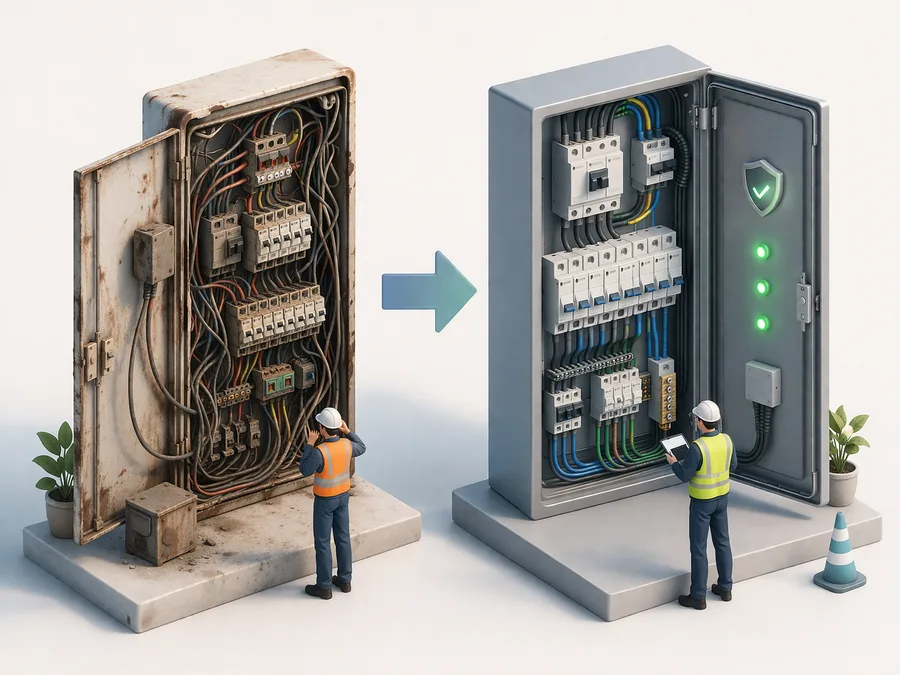
- New panel: A 200-amp breaker panel replaces the old 100-amp unit. More breaker slots, higher bus bar capacity, modern safety features including arc-fault and ground-fault protection on required circuits.
- New meter base: The outdoor meter socket that Hydro Ottawa reads must be rated for 200-amp service. Your old 100-amp meter base gets replaced.
- New service entrance cable: The heavy cable running from the overhead or underground Hydro Ottawa connection to your meter and then to your panel. The existing cable is undersized for 200 amps and must be replaced.
- Hydro Ottawa coordination: The utility needs to disconnect and reconnect power. Your electrician handles the coordination, but it means a planned outage of several hours on installation day.
- ESA inspection: An Electrical Safety Authority inspector verifies the completed work before the panel is energized. This is mandatory, not optional.
Costs in Ottawa
A 100-to-200 amp panel upgrade in Ottawa typically runs $2,000 to $4,000. The range depends on whether the meter base needs relocating, the length of the new service entrance cable, accessibility of the panel location, and how much rewiring of existing circuits is needed to bring everything up to current code.
If the upgrade involves moving the panel to a different location (sometimes done to create a more accessible, code-compliant installation), costs can reach $5,000 to $6,000.
EV Charger Installation: The Most Common Trigger
The single biggest reason Ottawa homeowners are upgrading panels right now is electric vehicle charging.
What You Need
A Level 2 home charger runs on a 240-volt circuit, typically 40 to 50 amps. That's a dedicated circuit from your panel to the garage or driveway location. The charger itself (sometimes called EVSE, for Electric Vehicle Supply Equipment) costs $500 to $1,200. Installation, including the panel circuit, wiring run, and outlet or hardwired connection, adds $800 to $2,000 depending on the distance from your panel to the charging location.
The Catch
If your panel is already at or near capacity, adding a 50-amp circuit isn't possible without an upgrade. This is where many Ottawa homeowners discover their 100-amp panel can't accommodate the EV charger they just bought.
Do the math before buying the car. Or at least before assuming your garage is charger-ready. A quick assessment from a licensed electrician ($100 to $200 for a panel evaluation) can save you from an unpleasant surprise.
Budget reality: If you need a panel upgrade plus the EV charger installation, you're looking at $3,000 to $6,000 total. That's worth factoring into the cost of EV ownership that the dealership brochure doesn't mention.
Aluminum Wiring: Ottawa's Other Electrical Problem
Between 1965 and 1976, many Ottawa homes were wired with aluminum branch circuit wiring instead of copper. This includes large swaths of Alta Vista, Manor Park, Carlington, and other neighbourhoods developed during that era.
Why It's a Concern
Aluminum expands and contracts more than copper when it heats and cools. Over decades, this loosens connections at outlets, switches, and junction boxes. Loose connections create resistance. Resistance creates heat. Heat creates fire risk. The Consumer Product Safety Commission found that homes with aluminum wiring are 55 times more likely to have one or more wire connections reach fire-hazard conditions.
The Fix: Pigtailing
The standard remediation is pigtailing: a licensed electrician attaches a short length of copper wire to every aluminum connection point using approved COPALUM or AlumiConn connectors. This creates a safe copper-to-device connection while keeping the existing aluminum wiring in the walls.
Cost: $3,000 to $6,000 for a typical Ottawa home, depending on the number of connection points.
Full Rewire
A complete rewire replaces all aluminum with copper. It's more expensive ($8,000 to $15,000+) and more invasive (walls need to be opened), but it permanently resolves the issue. This is often done during a major renovation when walls are already open.
Aluminum wiring is the most common finding on Ottawa home inspections for properties built in that era. If you're buying a home and the inspector flags it, get a quote for pigtailing and factor it into your offer.
Knob-and-Tube in Heritage Homes
Ottawa's heritage neighbourhoods, particularly the Glebe, Sandy Hill, New Edinburgh, and Centretown, contain homes with original knob-and-tube wiring dating to the early 1900s.
The Insurance Problem
Knob-and-tube wiring isn't automatically dangerous if it's untouched and in good condition. The problem is that most of it has been modified over 100 years: connections spliced improperly, insulation blown over the wires (knob-and-tube relies on air gaps for cooling), and circuits overloaded far beyond their original design.
Insurance companies in Ontario are increasingly refusing to write policies for homes with active knob-and-tube wiring, or they charge significant surcharges. Some require a certificate from a licensed electrician confirming the system is safe, which many electricians won't provide because the liability is too high.
Rewiring Costs
A full rewire of a heritage home in Ottawa costs $8,000 to $20,000 or more, depending on the size of the home and the difficulty of fishing new wire through century-old walls without destroying the plaster. Some heritage home rewires can be done with minimal plaster damage by an experienced electrician. Others require significant wall repairs afterward.
Heritage note: If your home is in a Heritage Conservation District, the exterior work associated with upgrading your electrical service (new meter base, service mast, or conduit on the exterior) may require a heritage permit in addition to the ESA permit. Plan for this. It adds time but not significant cost.
ESA Permits: What You Need to Know
Every piece of electrical work in Ontario, from adding a single outlet to upgrading a service entrance, requires a permit from the Electrical Safety Authority (ESA). This is provincial law, not a suggestion.
Who Pulls the Permit
Licensed electricians pull the permit as part of their scope of work. The permit number should appear on your invoice. If it doesn't, ask for it. If your electrician says a permit isn't necessary for the work being done, get a second opinion from a different electrician.
Homeowner Work
Ontario law allows homeowners to perform their own electrical work on their primary residence. But you still need to pull an ESA permit and book an inspection. The work must meet the Ontario Electrical Safety Code. If the ESA inspector fails your work, you fix it on your own time and dime until it passes.
Practically speaking, panel upgrades, service entrance changes, and anything involving the utility connection should be done by a licensed electrician. The risk-to-savings ratio of DIY on high-amperage work is not in your favour.
When to Upgrade
The trigger points are clear. If you're adding any major 240-volt appliance (EV charger, heat pump, hot tub, electric range, tankless electric water heater) and your panel is 100 amps or less, start the conversation with an electrician before you commit to the purchase. The panel upgrade should be budgeted as part of the project, not discovered as an unpleasant add-on halfway through installation.
If your home was built between 1965 and 1976, ask about aluminum wiring during the same visit. Addressing both issues at once saves on the second service call and may save on labour since the electrician is already working in your panel.
Your home's electrical system is the one thing you genuinely cannot afford to cut corners on. Not because of the code. Not because of insurance. Because electricity doesn't give second warnings. It gives fires. Get the panel assessment, pull the permits, hire a licensed professional, and do it right once.