
The Most Expensive Thing You Can't See From Inside
Your roof is the most expensive thing you can't see from inside your house. It takes a beating every winter: 220 centimetres of snow, repeated freeze-thaw cycles, ice dams, and the occasional Ottawa windstorm that rearranges your shingles. It asks for nothing in return except to not be ignored.
When it fails, everything underneath it fails too. A leaking roof doesn't just damage the roof. It damages the attic insulation, the ceiling drywall, the framing, and eventually the walls and floors below. A $12,000 roof replacement ignored for two years becomes a $25,000 roof-plus-interior repair.
Choosing a roofing material is like choosing a winter jacket. You want something that handles -30, sheds snow, and doesn't fall apart after three seasons. Unlike a jacket, though, this one costs $15,000 and you can't return it.
Roofing Materials for Ottawa's Climate
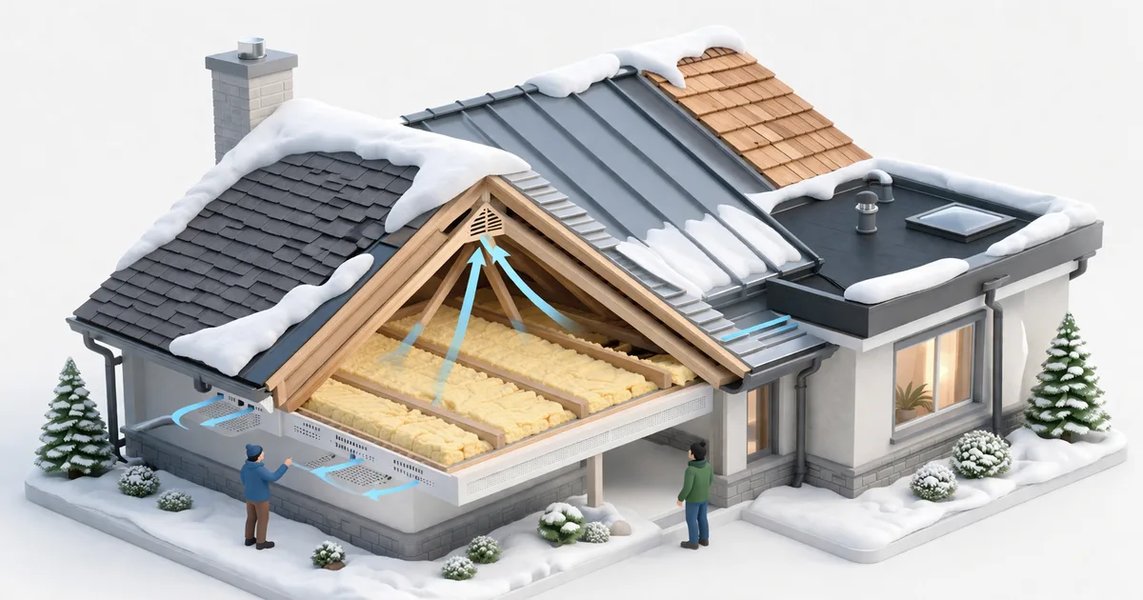
Not every roofing material works well here. Ottawa's combination of heavy snowfall, ice buildup, extreme cold, and summer heat creates conditions that some materials handle beautifully and others survive poorly.
Asphalt Shingles: $8,000 to $15,000
The standard. Roughly 80% of Ottawa homes have asphalt shingles, and for good reason: they're affordable, widely available, and every roofer in the city knows how to install them properly.
Architectural (dimensional) shingles are the minimum you should consider. They're thicker than three-tab shingles, handle freeze-thaw better, and carry 25 to 30-year warranties. Some premium lines (GAF Timberline, IKO Cambridge, CertainTeed Landmark) offer 50-year limited warranties, though the realistic lifespan in Ottawa's climate is 20 to 30 years.
The downside: asphalt shingles don't shed snow. Snow sits on them, melts from attic heat, refreezes at the eaves, and creates ice dams. This is manageable with proper attic insulation and ventilation, but it's a factor.
Metal Roofing: $20,000 to $35,000
Standing seam metal roofing is the premium choice for Ottawa. It sheds snow cleanly, handles freeze-thaw without deterioration, resists wind, and lasts 50+ years. If you're staying in your home long-term, metal is the buy-it-once option.
The catch: it costs roughly double what asphalt costs, and it requires specialized installers. Not every roofer does metal work, and the ones who do charge accordingly. A poorly installed metal roof will leak at every seam, and repairing it requires the same specialized knowledge. Make sure your installer has a track record with standing seam, not just metal roofing in general.
Snow guards are essential on metal roofs in Ottawa. Without them, the entire snow load slides off in a sheet, which is exciting in the way that an avalanche off your roof onto your front walkway is exciting. Snow guards hold the snow in place and let it melt gradually.
Cedar Shake: $15,000 to $25,000
Beautiful. Natural. The preferred look for heritage homes in Rockcliffe Park, the Glebe, and New Edinburgh. Cedar shakes age to a silver-grey that looks fantastic on a stone or brick century home.
The downsides: cedar requires more maintenance than any other roofing material. It needs treatment every 3 to 5 years to prevent moss, algae, and rot. It's a fire risk unless treated with fire retardant. And it has a shorter lifespan in Ottawa's wet, freeze-thaw climate than in drier regions. Expect 20 to 30 years with proper maintenance, less without it.
Flat/Rubber Roofing: $6,000 to $12,000
Common on row houses in Centretown, the Byward Market, and Lowertown, and on additions and garages with low-slope roofs. EPDM rubber or modified bitumen are the standard materials. Lifespan: 15 to 25 years.
Flat roofs in Ottawa need attention. Snow accumulates instead of sliding off, and pooling water from snowmelt can find even tiny membrane failures. Annual inspections are more important here than on any other roof type.
The Ice Dam Problem
Ice dams are Ottawa's most common roofing problem, and they're caused by your attic, not your roof.
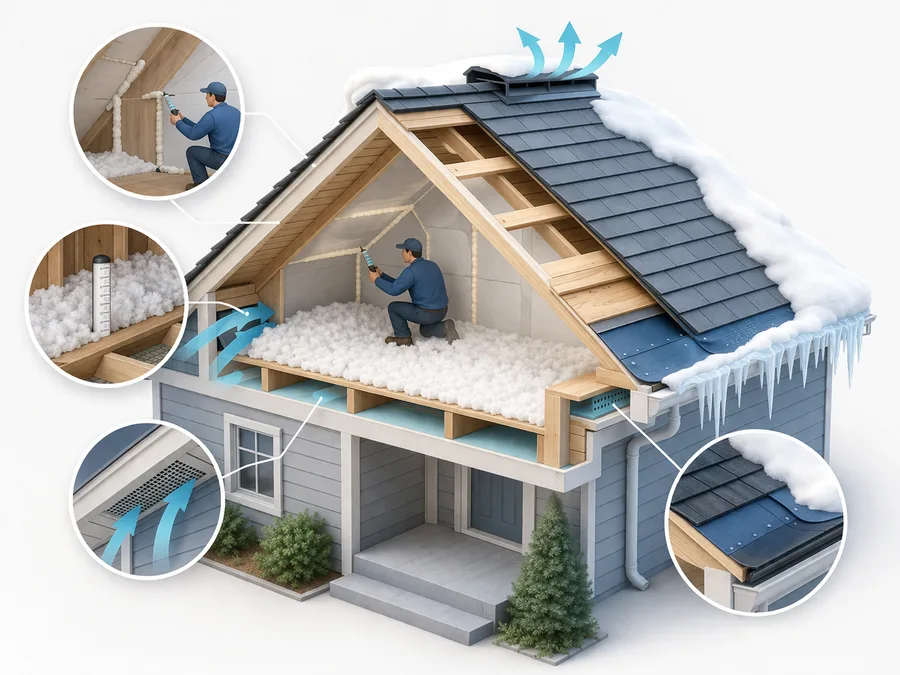
Here's the cycle: warm air leaks into your attic from the living space below. It heats the underside of the roof deck. Snow on the roof melts. The meltwater runs down to the eaves, which are colder because they overhang the exterior wall (no warm attic below). The water refreezes. Over days and weeks, a ridge of ice builds up along the eaves, trapping water behind it. That trapped water backs up under shingles and leaks into your home.
The fix is not the roof. The fix is the attic.

- Insulation: R-60 is the current code minimum for Ottawa attics. Many older homes have R-20 or less. Adding blown cellulose or fibreglass to reach R-60 costs $1,500 to $3,000 and is the single most effective ice dam prevention.
- Air sealing: Before adding insulation, seal every penetration from the living space into the attic. Pot lights, plumbing stacks, electrical boxes, attic hatches. Warm air leakage is the root cause.
- Ventilation: Soffit vents at the eaves and ridge vents at the peak create airflow that keeps the attic cold. Cold attic = no snowmelt = no ice dams.
- Ice and water shield: A self-adhering membrane installed on the first 3 feet of roof deck from the eave edge. This is a secondary defense, not a fix. It prevents water that does back up from entering the building. Ontario Building Code requires it on all new roofs and reroofs.
Gutter Systems: The Unsung Partners
Gutters don't get the same attention as roofing, but they handle everything the roof sheds. In Ottawa, that's a lot.
Seamless Aluminum
The standard in Ottawa. Seamless aluminum gutters are formed on-site from a continuous coil, so there are no joints to leak (except at corners and downspout connections). Cost: $8 to $15 per linear foot installed, depending on size and complexity. A typical Ottawa bungalow runs $1,200 to $2,500 for a full gutter replacement.
Leaf Guards
If you live on a treed lot, particularly in older neighbourhoods like Alta Vista, the Glebe, or Manor Park where mature trees overhang rooflines, gutter guards are worth the investment. They add $5 to $12 per foot but eliminate the twice-yearly gutter cleaning that nobody actually does on schedule.
Heated Gutter Cables
For chronic ice dam areas, self-regulating heat cables in the gutters and along the eave edge prevent ice buildup. They cost $500 to $1,500 installed and use surprisingly little electricity thanks to the self-regulating design. They're a band-aid, not a cure. Fix the attic insulation and ventilation first. But if you've done that and still get minor ice buildup, heated cables handle the rest.
How Not to Get Scammed
Roofing scams are one of the top complaint categories on Ottawa forums, and for good reason. The work happens above your sightline, it's hard for homeowners to inspect, and the damage from bad work doesn't show up for months or years.
Avoid Door-to-Door Roofers
If someone knocks on your door and tells you they noticed damage on your roof, be skeptical. This is the most common roofing scam entry point in Ottawa. Legitimate roofers have enough work. They're not walking through Kanata looking for shingles to point at.
Get Three Written Quotes
Written quotes with itemized materials, labour, waste removal, and warranty terms. Compare them line by line. A quote that's 40% below the other two is not a deal. It's a contractor who's cutting corners on materials, skipping the ice and water shield, or planning to use two layers of shingles instead of stripping to the deck.
Check Insurance and WSIB
Roofing is dangerous work. If an uninsured worker falls off your roof, you can be liable. Ask for proof of liability insurance and WSIB (Workplace Safety and Insurance Board) coverage. Legitimate contractors have both and will show them without hesitation.
Beware Proprietary Systems
There's an infamous Ottawa story about a homeowner who paid $80,000 for a proprietary metal roof system. When it leaked, no other roofer could repair it because it used non-standard components that only the original installer carried. The original installer was unresponsive. The homeowner spent six years fighting leaks that nobody else could fix.
Standard materials installed by standard methods mean any qualified roofer can maintain and repair your roof. Proprietary systems lock you into a single company forever. Think about whether that company will still exist in 15 years.
When to Book and How to Plan
The best time to book a roofer in Ottawa is March or April for a summer installation. By May, the good crews are booked into August. Fall rush (September and October, when everyone suddenly remembers their roof before winter) means higher prices and limited availability.
Signs you need a new roof sooner rather than later:
- Shingles are curling, cracking, or losing granules (check your gutters for grit)
- You can see daylight through the roof boards from inside the attic
- The roof is visibly sagging
- You're finding stains on the ceiling after rain or snowmelt
- The roof is 20+ years old with original shingles
A roof inspection costs $200 to $400 and tells you exactly where you stand. It's the cheapest insurance against the $25,000 surprise.
Your roof works hard. Harder than any other part of your house. 220 centimetres of snow, -30C nights, spring deluges, summer sun. Give it the respect of good materials, proper installation, and the attic insulation to keep ice dams from undermining everything. The roof over your head is only as good as the decisions you made when you last paid attention to it.