Permis de construction à City of London
Un guide complet pour les propriétaires.
Comprenez de quels permis vous avez besoin, comment faire une demande et quelles autres approbations peuvent s'appliquer à votre projet de rénovation.
Quand avez-vous besoin d'un permis de construction?
En vertu du Code du bâtiment de l'Ontario, des permis de construction municipaux sont requis pour la plupart des travaux de structure, de plomberie, de CVCA et d'électricité.
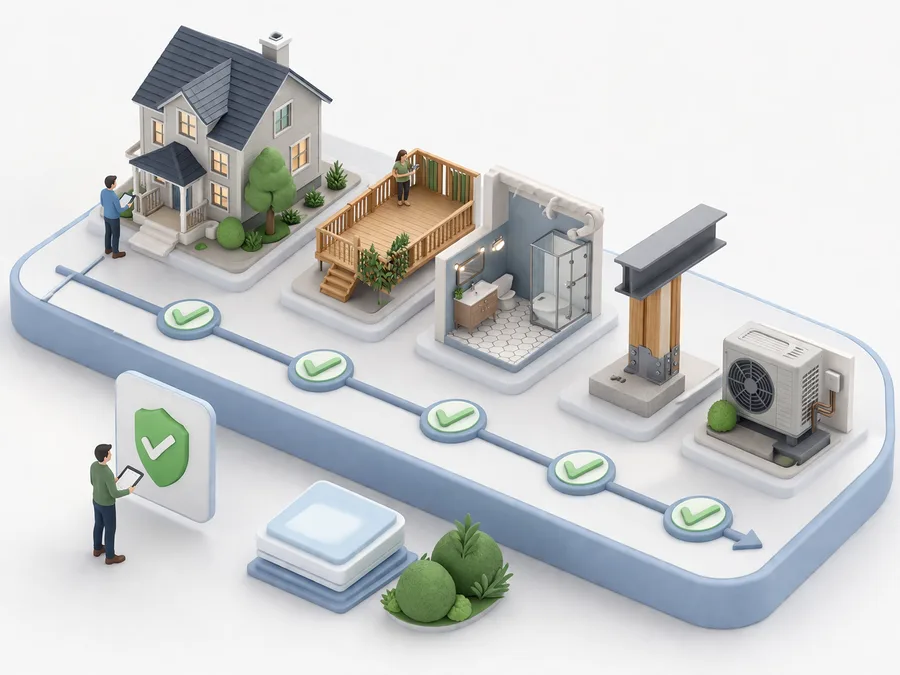
Permis généralement requis
-
Modifications structurelles
Murs porteurs, fondations, agrandissements
-
Installations ou modifications de plomberie
-
Installations ou modifications de CVAC
-
Finition d'un sous-sol
Lorsqu'il ajoute un espace habitable
-
Terrasses à plus de 600 mm
Plus de 24 pouces au-dessus du sol
-
Structures détachées
Dépassant le seuil de taille municipal
-
Nouvelles ouvertures de fenêtres ou de portes
Dans les murs porteurs
-
Installations de foyer ou de poele a bois
-
Sous-œuvre
Abaissement des planchers de sous-sol
-
Démolition
De bâtiments ou de structures
Permis généralement non requis
-
Peinture, revêtements de sol, cloisons sèches non structurelles
-
Remplacement d'armoires
Aucune modification de plomberie ou d'électricité
-
Réfection de toiture avec le même matériau
Aucune modification structurelle
-
Remplacement identique de fenêtre ou de porte
Dans la même ouverture
-
Aménagement paysager mineur
Qui ne modifie pas le drainage ou le nivellement
Vérifiez toujours avant de commencer
Les exemptions peuvent varier selon la municipalité et la portée du projet. Confirmez avec Development Services - Building Division avant de commencer les travaux.
Le processus de permis de City of London
Comment faire une demande de permis de construction auprès de Development Services - Building Division.
Où faire la demande
Frais, délais & contact
Comment faire une demande, etape par etape
-
1
Confirm whether a permit is required
Review the Ontario Building Code permit triggers and check this guide for your specific project type. When in doubt, contact London's Building Division at 519-661-4555.
-
2
Verify zoning compliance
Check your property's zoning using London's interactive CityMap on the Zoning page. Confirm setbacks, lot coverage, and height limits before investing in architectural drawings.
-
3
Check for heritage designation
Look up your address in London's Register of Cultural Heritage Resources. London has seven Heritage Conservation Districts. If your property is designated or in an HCD, exterior changes need Heritage Alteration Permit approval.
-
4
Confirm UTRCA jurisdiction
If your property is near a watercourse, wetland, flood plain, or hazard land, contact the Upper Thames River Conservation Authority (UTRCA) before applying for a building permit.
-
5
Prepare your application package
Collect the required drawings for your project type: site plan, floor plans, structural drawings where required, and energy efficiency compliance (SB-12) for housing.
-
6
Submit through the London Building e-Portal
Create an account on London's Building e-Portal, submit your application and drawings, and pay the applicable fees. Fees are calculated using the Service Index formula in By-law B-7.
-
7
Book your inspections
Once your permit is issued, schedule inspections through the e-Portal or by calling 519-661-4555. Check your permit card for the list of required inspections at each construction stage.
Autres approbations dont vous pourriez avoir besoin
Au-dela du permis de construction municipal, votre projet peut necessiter des approbations provinciales ou locales supplementaires.
Projets de rénovation courants à City of London
Exigences typiques de permis et d'approbation par type de projet. Les projets individuels peuvent différer; vérifiez toujours auprès de Development Services - Building Division.
| Projet | Batiment | ESA | TSSA | Plomberie | Conservation | Patrimoine |
|---|---|---|---|---|---|---|
|
Basement finishing
Converting an unfinished basement into habitable living space (new walls, ceilings, flooring, and typically new electrical and sometimes plumbing).
|
Requis | Requis | Le cas échéant | Le cas échéant | Non | Non |
|
Kitchen renovation
Cabinet replacement, countertop swap, and appliance changes with potential plumbing, electrical, or gas modifications.
|
Le cas échéant | Le cas échéant | Le cas échéant | Le cas échéant | Non | Non |
|
Bathroom addition
Adding a new bathroom (typically in a basement or converted space) requiring new plumbing drains, vents, and fixtures.
|
Requis | Requis | Non | Requis | Non | Non |
|
Deck (residential)
Building or replacing an exterior deck attached to a house or freestanding.
|
Le cas échéant | Le cas échéant | Non | Non | Le cas échéant | Le cas échéant |
|
Load-bearing wall removal
Removing an interior load-bearing wall (e.g., to open a kitchen to a living area) and installing a beam or header.
|
Requis | Le cas échéant | Non | Le cas échéant | Non | Le cas échéant |
|
Addition (single-storey or second-storey)
Adding new habitable space to a home: bump-out, new room, second-storey addition, or sunroom conversion.
|
Requis | Requis | Le cas échéant | Le cas échéant | Le cas échéant | Le cas échéant |
|
Window or door replacement
Replacing an existing window or door, or creating a new opening in an exterior wall.
|
Le cas échéant | Non | Non | Non | Non | Le cas échéant |
|
Roof replacement (reroofing)
Replacing an existing roof with the same or different materials (shingle, metal, membrane).
|
Le cas échéant | Non | Non | Non | Non | Le cas échéant |
|
Furnace replacement
Replacing an existing furnace (gas or electric) with a comparable new unit.
|
Le cas échéant | Le cas échéant | Le cas échéant | Non | Non | Non |
|
Central air conditioning installation
Installing or replacing a central air conditioning system (split system with exterior condenser and interior coil).
|
Le cas échéant | Requis | Non | Non | Non | Non |
|
Gas fireplace installation
Installing a new gas fireplace, insert, or stove with associated venting and gas line.
|
Requis | Le cas échéant | Requis | Non | Non | Le cas échéant |
|
Swimming pool (inground)
Installing an inground swimming pool including excavation, shell, equipment pad, and required fencing.
|
Requis | Requis | Le cas échéant | Requis | Le cas échéant | Non |
|
Fence
Installing or replacing a residential fence along a property line.
|
Varie | Non | Non | Non | Le cas échéant | Le cas échéant |
|
Detached garage or large shed
Building a detached accessory structure such as a garage, large shed, or workshop.
|
Le cas échéant | Le cas échéant | Non | Non | Le cas échéant | Le cas échéant |
|
Basement underpinning (lowering floors)
Lowering an existing basement floor by excavating and extending the foundation downward in sections.
|
Requis | Le cas échéant | Non | Le cas échéant | Non | Le cas échéant |
|
Solar panel installation
Installing a rooftop or ground-mount photovoltaic (PV) system with inverter and electrical interconnection.
|
Requis | Requis | Non | Non | Non | Le cas échéant |
|
Electric vehicle (EV) charger installation
Installing a Level 2 (240V) EV charging station in a garage, driveway, or parking area.
|
Non | Requis | Non | Non | Non | Non |
|
Demolition
Demolishing a building or a significant portion of a building (garage, accessory structure, interior gut).
|
Requis | Requis | Requis | Requis | Le cas échéant | Le cas échéant |
Obtenez des soumissions de pros de City of London qui gèrent les permis
Évitez les suppositions. Connectez-vous avec des professionnels vérifiés de City of London qui comprennent le processus de permis et peuvent soumissionner pour l'ensemble de votre projet.
Obtenir des soumissions gratuitesQuestions fréquemment posées
When do I need a building permit in London?
Under the Ontario Building Code, a permit is typically required for structural changes, additions, finished basements that add habitable space, decks more than 600 mm above grade, new plumbing, HVAC installations, and demolitions. Cosmetic changes like paint, flooring, and like-for-like fixture replacements generally do not. Contact London's Building Division at 519-661-4555 to confirm.
How do I apply for a building permit in London?
London accepts online building permit applications through the Building e-Portal. You will need a site plan, floor plans, structural drawings (where required), and energy efficiency compliance documentation for housing. Fees are calculated using the Service Index formula in By-law B-7.
How long does it take to get a building permit in London?
London follows Ontario Building Code statutory review timelines: 10 business days for houses, 15 days for small buildings, 20 days for large buildings, and 30 days for complex buildings. These timelines begin once your application is deemed complete.
What is the Building e-Portal?
London's Building e-Portal is the online system for submitting permit applications, uploading drawings, paying fees, tracking application status, and scheduling inspections. You need to create an account to access the portal.
Do I need UTRCA approval in London?
The Upper Thames River Conservation Authority (UTRCA) regulates development near watercourses, wetlands, flood plains, and hazard lands throughout London. If your property is in a UTRCA-regulated area, you may need their approval before the city can issue your building permit.
Is my London property in a Heritage Conservation District?
London has seven designated Heritage Conservation Districts: Bishop Hellmuth, Blackfriars/Petersville, Downtown, East Woodfield, Old East, West Woodfield, and Wortley Village-Old South. If your property is designated or in an HCD, exterior alterations need a Heritage Alteration Permit in addition to a building permit.
Do I need an ESA permit for electrical work in London?
Yes. The Electrical Safety Authority (ESA) requires a notification for all electrical work in Ontario, regardless of municipality. Homeowners can file ESA notifications for work on their own home, or hire a Licensed Electrical Contractor (LEC). This is separate from your municipal permit.
Do I need a TSSA permit for gas work in London?
Gas work (furnaces, gas fireplaces, gas lines, BBQ hookups) must be performed by a TSSA-certified gas technician with G1 or G2 certification. TSSA-certified contractors handle the regulatory notification and inspection process for you.
Avis importants
- This information is for general guidance only and does not constitute legal or professional advice.
- Permit requirements vary by municipality and project. Always confirm with your local building department.
- Information is current as of the date shown. Municipal requirements change - verify before relying on this information.
- RealCraft is not affiliated with any municipal, provincial, or federal government body.
Dernière vérification :